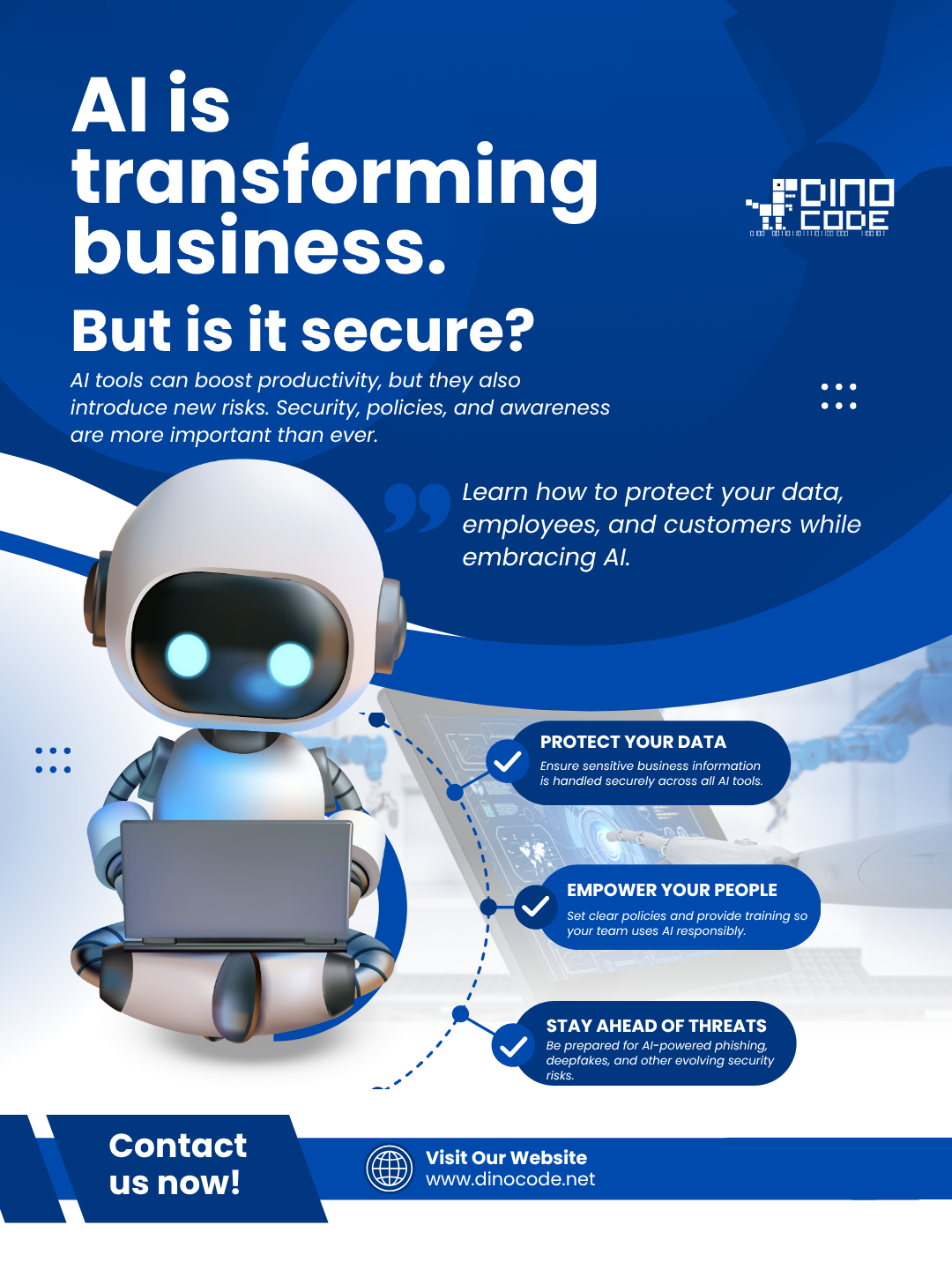
Artificial intelligence has become part of everyday business. Companies are using it to write content, analyze data, automate customer service, generate software code, and even support decision-making. What once seemed like a futuristic concept is now helping businesses save time and improve productivity every single day. But while organizations are rushing to adopt AI, many are overlooking one critical question:
Is it secure?
Cybersecurity has always been a moving target. Every time technology evolves, so do the tactics used by cybercriminals. AI is no exception. In fact, it’s creating an entirely new set of security challenges that businesses need to understand before they become costly problems.
The good news is that AI doesn’t have to be a security risk. With the right strategy, businesses can enjoy the benefits of AI while protecting their data, employees, and customers.
AI Is Powerful—But It Also Expands Your Attack Surface
Every new technology introduces new opportunities, and unfortunately, new vulnerabilities. When companies started moving to the cloud, security practices had to evolve.
When employees began working remotely, organizations had to rethink access controls and endpoint security.
Now AI is changing the landscape again. Every AI tool connected to your business systems has access to information. Depending on how it’s configured, it may process customer records, internal documents, financial reports, source code, or confidential business plans. If those systems aren’t properly secured, they can become another entry point for attackers.
That’s why AI security isn’t just an IT issue anymore—it’s a business issue.
The Biggest Risk Isn’t Always the Technology
When people hear “AI security,” they often imagine sophisticated hackers attacking advanced machine learning systems.
While that can happen, many of the biggest risks come from something much simpler:
everyday employee behavior.
Imagine an employee working under a tight deadline.
To save time, they copy confidential financial data into a public AI chatbot to generate a report.
Or a developer pastes proprietary source code into an online AI tool for debugging assistance. Neither employee intended to create a security problem.
They were simply trying to work more efficiently. Without clear policies, situations like these happen more often than many organizations realize.
AI tools are incredibly useful—but businesses need guidelines that help employees use them responsibly.
Cybercriminals Are Using AI Too
Artificial intelligence isn’t just helping businesses become more productive. It’s also helping attackers become more convincing.
Phishing emails, for example, have changed dramatically over the past few years.
They used to be easy to spot because of poor grammar, awkward wording, or obvious mistakes.
Today, AI can generate professional-looking emails that sound remarkably authentic.
Attackers can personalize messages using publicly available information, making them far more believable than traditional phishing attempts.
Imagine receiving an email that references a recent meeting, mentions one of your coworkers by name, and uses your company’s writing style.
That’s no longer difficult to create.
This is why cybersecurity awareness remains just as important as investing in new security software.
Technology can block many threats, but informed employees are often the last line of defense.
Deepfakes Are No Longer Science Fiction
A few years ago, deepfake videos seemed like something you’d only see in movies or on social media.
Today, they’re becoming a genuine business concern.
AI can now generate convincing audio and video that imitates real people with surprising accuracy.
Imagine receiving a voice message that sounds exactly like your CEO asking you to transfer funds to a vendor immediately.
Or a video call appearing to come from a trusted executive requesting sensitive company
information.
These scenarios are becoming increasingly realistic.
Businesses should never rely solely on voice or video confirmation for financial approvals or sensitive decisions.
Simple verification procedures—like confirming requests through a second communication channel—can prevent costly mistakes.
Data Is Your Most Valuable Asset
Every business collects data.
Customer information.
Employee records.
Financial documents.
Contracts.
Sales reports.
Marketing analytics.
Product designs.
For many organizations, this information is far more valuable than physical assets.
When AI systems process that data, businesses need confidence that it’s being handled
securely.
Before adopting any AI platform, leaders should ask important questions:
- Where is our data stored?
- Is it encrypted?
- Who has access to it?
- Is customer information used to train public AI models?
- What happens if we decide to stop using the service?
Understanding these answers helps businesses make informed decisions instead of relying
on assumptions.
Security Starts with Good Governance
Technology alone cannot solve security problems.
Successful organizations establish clear policies before deploying AI tools across the
company.
Employees should know: - Which AI platforms are approved for business use.
- What types of information should never be shared with AI.
- When human review is required.
- Who is responsible for managing AI systems.
- How AI-generated content should be verified before publication.
Having clear expectations reduces confusion and minimizes unnecessary risk.
More importantly, it creates consistency across the organization.
Building AI Into Your Security Strategy
AI security shouldn’t be treated as a separate project.
It should become part of your existing cybersecurity strategy.
That means reviewing AI tools with the same level of scrutiny as any other software your
business adopts.
Ask questions like: - Does this platform meet our compliance requirements?
- Does it support multi-factor authentication?
- Can we control employee access?
- Are activity logs available?
- How frequently are security updates released?
Thinking about these questions early prevents larger problems later.
Security is always easier to build into a system than to add after it’s already in production.
The Role of Employee Training
Even the most advanced security systems have limitations.
Employees still make decisions every day that affect your organization’s security posture.
That’s why ongoing education is just as important as firewalls and endpoint protection.
Training doesn’t have to be complicated.
Simple awareness sessions can teach employees how to: - Recognize AI-generated phishing attempts.
- Protect confidential information.
- Use approved AI tools safely.
- Verify unusual requests.
- Report suspicious activity quickly.
The goal isn’t to make employees fearful of AI.
It’s to help them use it confidently and responsibly.
AI Security Is an Ongoing Process
One common mistake businesses make is treating cybersecurity as a one-time investment.
Security isn’t something you buy once and forget.
The same applies to AI.
New tools appear every month.
New vulnerabilities are discovered regularly.
Attack techniques continue to evolve.
Businesses that review their AI usage, update policies, and monitor systems regularly will
always be in a stronger position than those who assume everything is secure simply
because it worked yesterday.
Staying proactive is far less expensive than recovering from a security incident.
How Dinocode Solutions Helps Businesses Adopt AI Securely
At Dinocode Solutions, we believe innovation should never come at the expense of
security.
Helping businesses adopt AI isn’t just about implementing new technology—it’s about
making sure that technology is reliable, scalable, and secure from day one.
Our team works with organizations to design AI solutions that align with existing security
practices while supporting long-term business growth.
Whether you’re modernizing your infrastructure, integrating AI into daily operations, or
developing custom software, we help ensure your systems are built with security in mind.
Because the best technology isn’t simply intelligent.
It’s trustworthy.
Final Thoughts
Artificial intelligence is changing the way businesses operate, and its impact will only
continue to grow.
But as organizations embrace automation and intelligent systems, they must also
recognize the responsibility that comes with using them.
Strong AI security isn’t about slowing innovation.
It’s about creating the confidence to innovate safely.
Businesses that invest in governance, employee education, secure infrastructure, and
trusted technology partners will be better prepared for the future—no matter how quickly
technology evolves.
AI has the potential to transform your business.
Just make sure security is part of the journey from the very beginning.
Ready to Build AI Solutions You Can Trust?
AI should make your business more efficient—not more vulnerable.
At Dinocode Solutions, we help organizations implement secure, scalable AI, cloud, and
software solutions designed around real business needs.
Whether you’re exploring AI for the first time or strengthening your existing technology, our
team is here to help you innovate with confidence.
Contact Dinocode Solutions today and discover how secure technology can power
your next stage of growth.